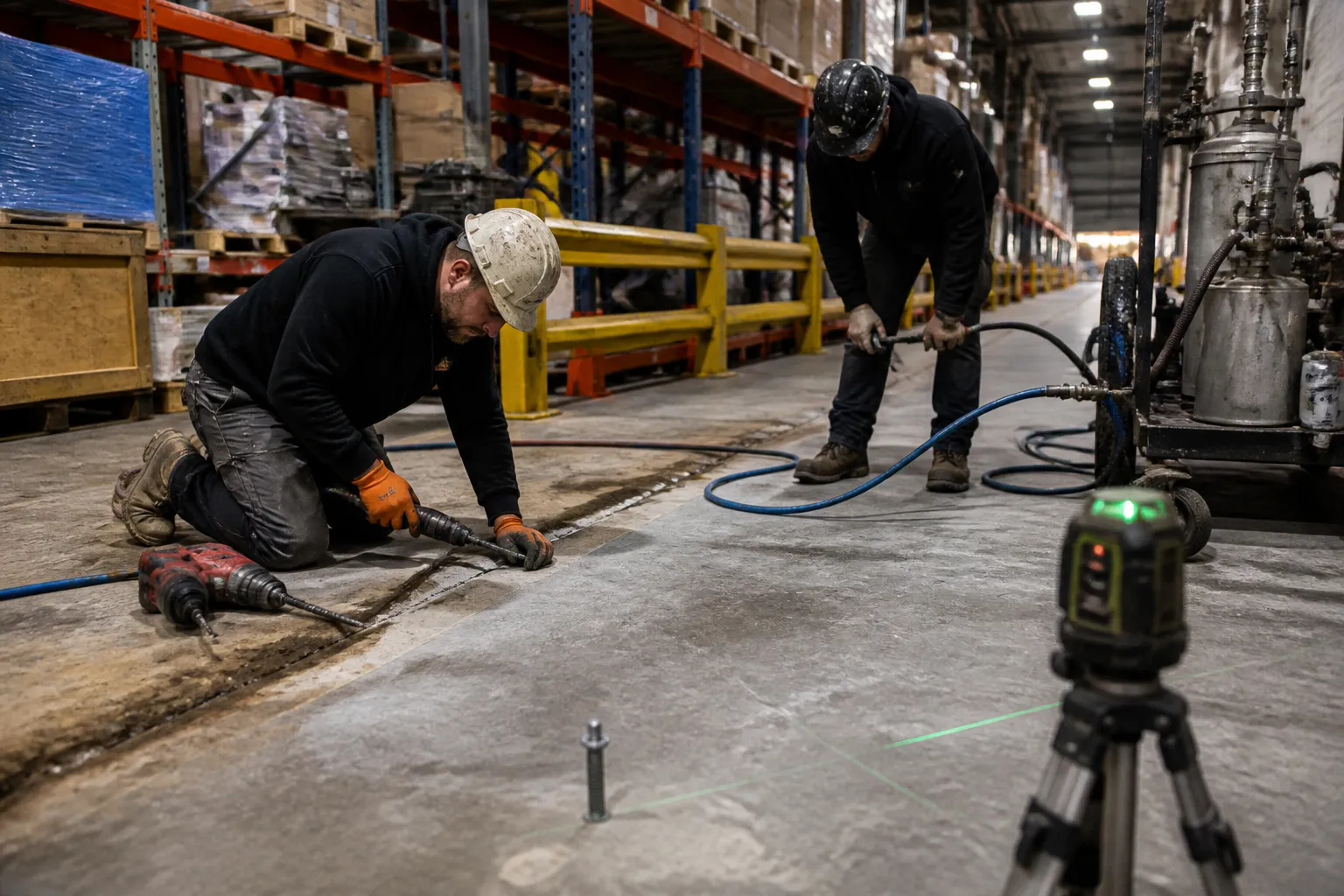
Settlement in a warehouse or industrial floor can affect more than appearance. A dropped slab joint, uneven loading area, or void beneath a traffic lane can interfere with forklift travel, material movement, loading operations, and safe pedestrian routes.
Toronto Concrete Leveling evaluates serviceable warehouse slabs, industrial floors, loading docks, and loading areas for concrete lifting and slab stabilization. We focus on the settlement pattern, slab joints, heavy-use areas, and the conditions beneath the floor before recommending a method.
Commercial and industrial sites often need a focused repair plan that respects active facility operations and minimizes unnecessary downtime.
Industrial concrete relies on compacted fill and consistent subgrade support. Water washout, disturbed soils, groundwater movement, utility trenches, and void formation can leave a slab partially unsupported. Repeated heavy loads may expose the resulting movement at control joints and transitions.
Polyurethane injection can be used through small ports to fill subsurface voids and provide controlled support below a slab. The lightweight material and rapid cure time can make it appropriate where site access and operational continuity matter. The goal may be void filling and stabilization, slab lifting, or both, depending on the observed conditions.
We review access, traffic lanes, slab use, nearby loading activity, and required elevation corrections. A repair should fit the working environment as well as the concrete condition.
Leveling can be appropriate where concrete remains serviceable and settlement is linked to support loss below the slab. Severely deteriorated slabs or extensive structural damage may require a different approach. We do not present lifting as a substitute for repair when the slab is no longer a good candidate.
For offices, retail sites, managed properties, and pedestrian areas, see commercial concrete leveling. For void-specific work, visit concrete void filling and slab stabilization. You can also return to our homepage for Toronto concrete lifting information.
It can be considered when the slab and subsurface conditions support a targeted injection approach.
Yes. Where elevation is acceptable, the primary objective may be to restore support by filling empty space below the slab.
Water movement, erosion, settlement of fill, and disturbed soils around trenches or services can all contribute.
Traffic patterns, slab joints, elevation differences, and the operating environment are reviewed as part of the repair plan.
Suitability depends on the slab condition, transition geometry, and the support beneath the concrete.
No. The condition of the concrete and cause of movement determine whether lifting is a practical option.
Contact Toronto Concrete Leveling to discuss a settled warehouse floor, loading area, or industrial slab in Toronto and the GTA.
Start With a Site Review
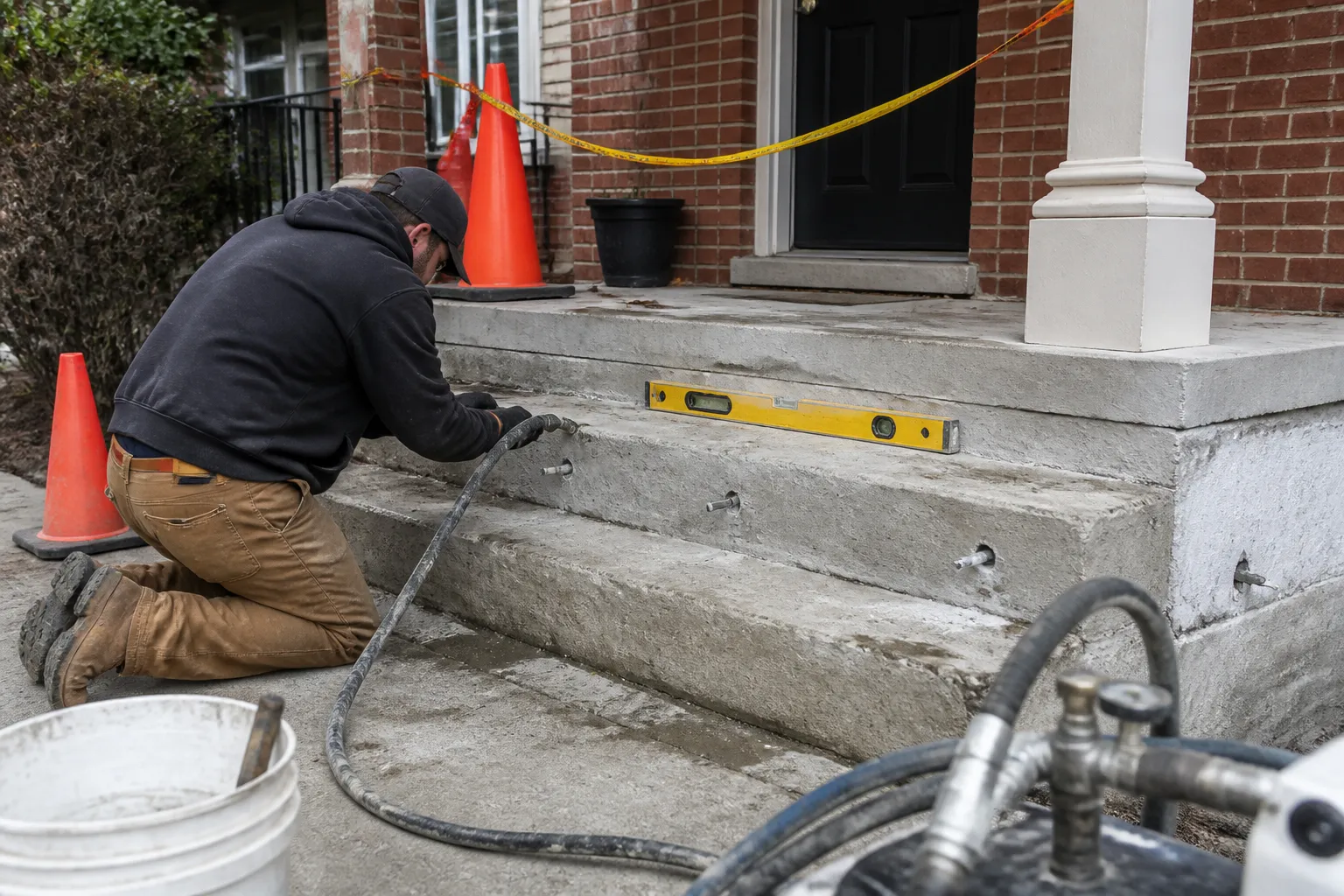
Tell us about your settled driveway, uneven sidewalk, sunken patio, or garage floor, and we will help you understand whether leveling, lifting, or another repair path is the best fit.