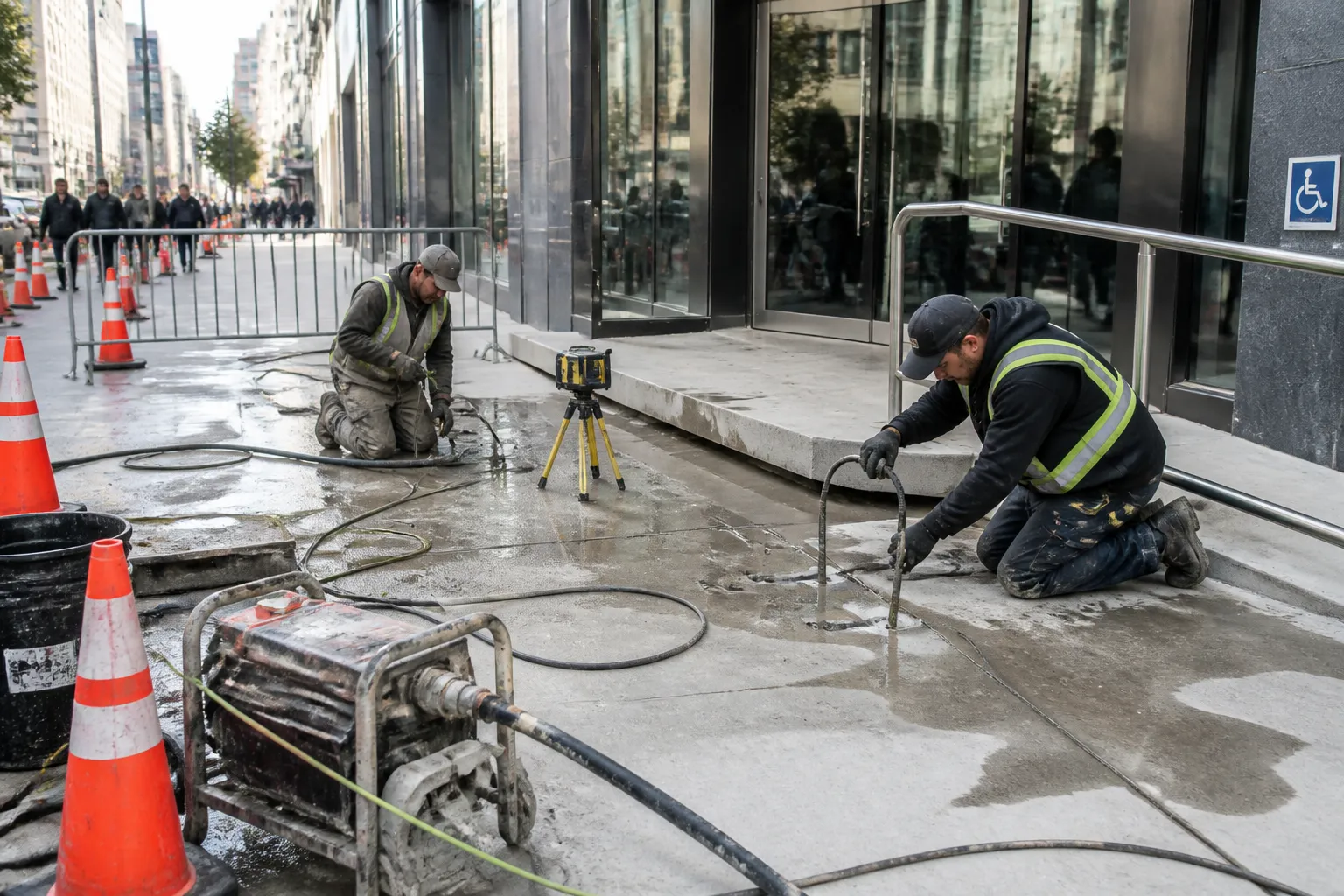
Uneven concrete at a business property can become hard to ignore fast. A sunken sidewalk, a settled entry pad, or a cracked loading area can create trip hazards, slow down foot traffic, and make the property look neglected.
Toronto Concrete Leveling helps property owners and managers address these conditions with commercial concrete leveling across Toronto, ON. If the slab is still sound but has dropped, we can often lift it back into place with polyurethane foam injection, slab jacking, or related concrete lifting methods instead of full removal and replacement.
Commercial concrete does not usually sink all at once. It often shifts slowly, then becomes obvious when people start noticing the change in grade, the height difference at a joint, or the way water sits near the slab edge.
These signs matter because a settled slab can keep moving if the cause is not addressed. A repair that lifts the concrete without understanding the underlying movement may not last as long as it should. That is why we start by looking at the surface condition, the pattern of settlement, and the location of the affected slab.
Commercial properties use concrete in more places than most people realize. When any one of those surfaces changes height, it can affect safety, access, and day-to-day use of the site.
Commercial Concrete Leveling can help restore a range of surfaces across Toronto, ON, including:
We work with property managers, business owners, commercial operators, and municipalities who need a practical fix for uneven concrete. Some properties need a single lift at a main walkway. Others have several sections that have dropped over time. In either case, the goal is the same: restore usable concrete without replacing slabs that still have life left in them.
At Toronto Concrete Leveling, we use methods that raise settled concrete from below and help support the slab again. The right approach depends on how the concrete has moved, how much void space exists beneath it, and what kind of surface needs to be restored.
We look at the affected concrete, note the depth and direction of settlement, and check for signs that help explain why the slab moved.
We select a leveling method suited to the slab, the access conditions, and the amount of lift needed.
Polyurethane foam injection, polyjacking, mudjacking, or slab jacking is used to fill voids and bring the slab back up.
We make careful height adjustments so the slab aligns with surrounding concrete, transitions, and access points.
These methods are often a strong option when the concrete is still structurally worth saving. If a section is too broken, too deteriorated, or no longer suitable for leveling, replacement may be the better path. We will not push leveling where it does not fit the condition of the slab.
Different commercial sites call for different repair materials. The most suitable method depends on the condition of the slab, the expected use of the area, and the result needed for the property.
This method uses expanding foam to fill voids and lift settled concrete. It is often chosen when a lighter, more precise lift is needed or when the property needs a repair approach that keeps disruption low.
Slab jacking and mudjacking use a pumped material beneath the slab to restore support and raise the concrete. These methods can work well for certain commercial slabs where the surface is still stable enough to be lifted and reset.
Polyjacking is another name commonly used for foam-based lifting. It is a useful option for many commercial concrete surfaces because it targets the space under the slab rather than relying on demolition.
Each method has its place. The point is not to force one repair type onto every slab. The point is to match the fix to the movement, the access, and the condition of the concrete.
Commercial properties cannot always afford long shutdowns around walkways, drive lanes, or customer access points. Concrete leveling is often chosen because it restores the slab without the noise, debris, and downtime that come with full replacement.
That reduced disruption can matter just as much as the repair itself. When a surface is used daily by staff, visitors, or service vehicles, a focused leveling job can be a much more practical path than replacing an entire area for one sunken section.
Every commercial slab tells a different story. Before recommending a repair, we look at the conditions that influence how the concrete moved and whether leveling is the right answer.
A single dropped corner may need a different approach than a long settled run of sidewalk or a broad area of slab movement.
Concrete with major structural damage may not be a good candidate for lifting.
Some sites allow easier equipment placement than others, which can affect repair method and setup.
Pedestrian walkways, vehicle paths, and entry areas all place different demands on the repaired slab.
Doors, ramps, curbs, and adjoining slabs all need to be considered so the finished surface connects cleanly.
For business properties, the right repair is not just about lifting a slab. It is about restoring the surface so it makes sense within the way the property is used.
Toronto Concrete Leveling focuses on concrete that can be saved with careful lifting rather than removed and replaced. Commercial sites often have several different surfaces, and each one may show settlement in a slightly different way.
We do not treat every surface the same way. A loading approach that works for one slab may not fit a sidewalk or pool deck. That is why commercial concrete leveling is most effective when the repair method is matched to the location and the use of the concrete.
The slab usually needs to be sound enough to handle a lift and reset. If the concrete is badly broken, crumbling, or no longer stable, replacement may be the better choice.
Yes, leveling is often used to reduce height differences that create trip hazards at sidewalks, entries, and other access points. The repair is aimed at bringing the slab back to a more even position.
Yes. Some commercial sites benefit from a mix of polyurethane foam injection, slab jacking, mudjacking, or polyjacking depending on the slab and the conditions underneath it.
It can, depending on the layout and the condition of the concrete. Some projects involve one section, while others cover several connected slabs across a commercial property.
We look for signs that help explain the movement before recommending a repair. When the underlying issue is understood, the repair plan can be matched more carefully to the slab and its setting.
Often, yes. That is one of the main reasons commercial property owners contact us. If the concrete is still a good candidate, lifting may restore the surface without full demolition.
If a commercial sidewalk, driveway, patio, garage floor, or other concrete surface has settled at your property, Toronto Concrete Leveling can help you understand the repair options. We focus on practical solutions for Toronto, ON properties that need uneven concrete restored without unnecessary replacement.
Call +16477005472 to discuss the condition of your slab and the next step for your site. Our address is 452 Glebeholme Boulevard, and we serve commercial properties throughout Toronto and the Greater Toronto Area.
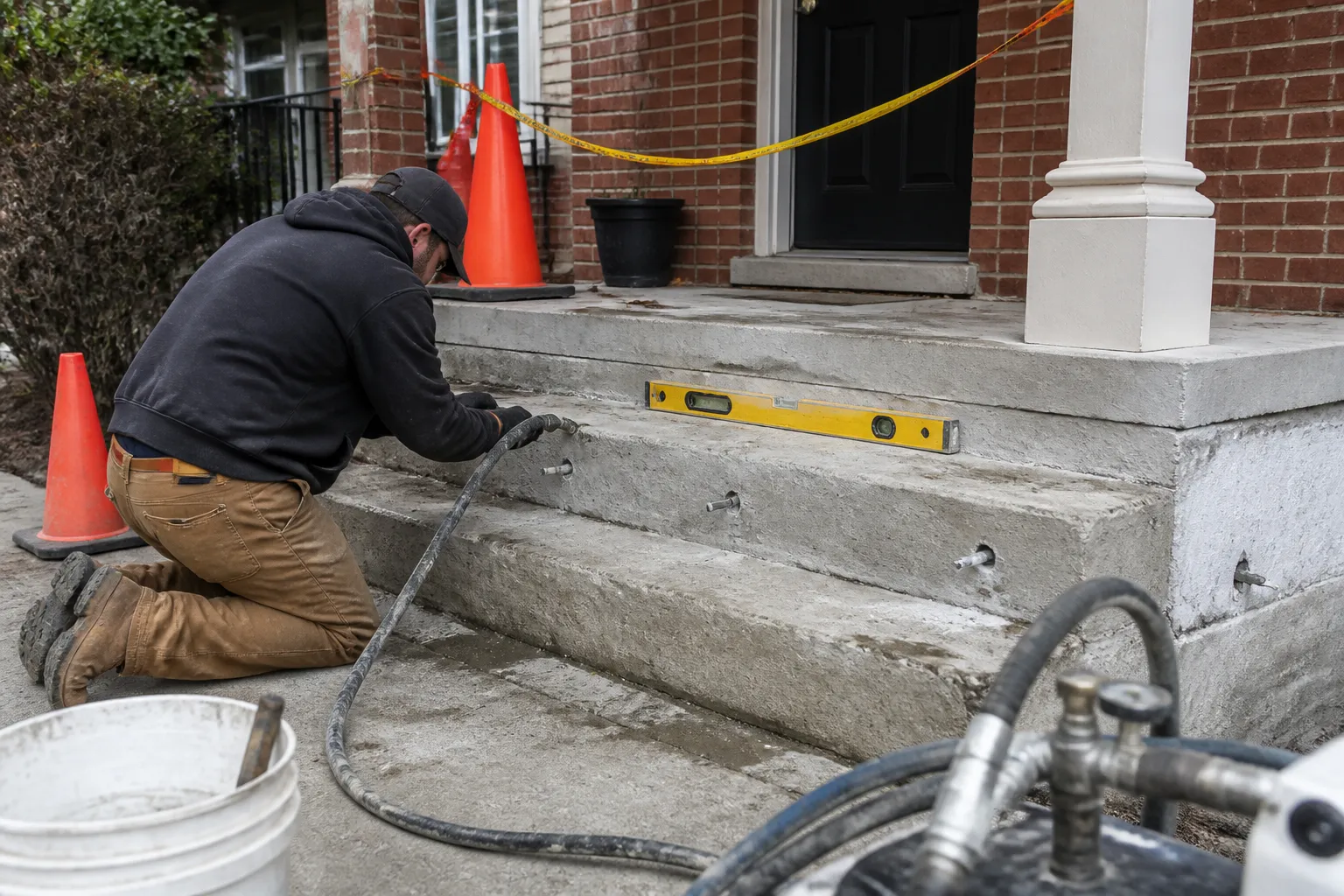
Start With a Site Review
Tell us about your settled driveway, uneven sidewalk, sunken patio, or garage floor, and we will help you understand whether leveling, lifting, or another repair path is the best fit.